Free delivery for purchases over €60 within Metropolitan France.

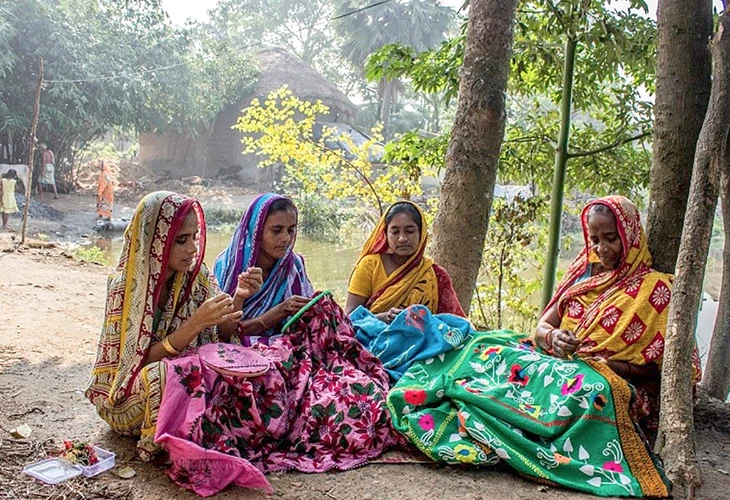
Women in Bengal and Rajasthan, India, transform damaged saris with wear and tear or snags into new second-hand textiles. Their embroidery skills transform used fabrics into true works of art. Today, we are rediscovering the virtues of buying second-hand in a context where we are finally becoming aware of excessive consumption and its harmful effect on the planet (source). However, this art of recycling has been generating exceptional textile expertise in India for centuries.
Let us explain!
You may be familiar with the term ‘sari’. It refers to a piece of silk or cotton fabric that can be up to 12 metres long, which Indian women wear with incomparable elegance.
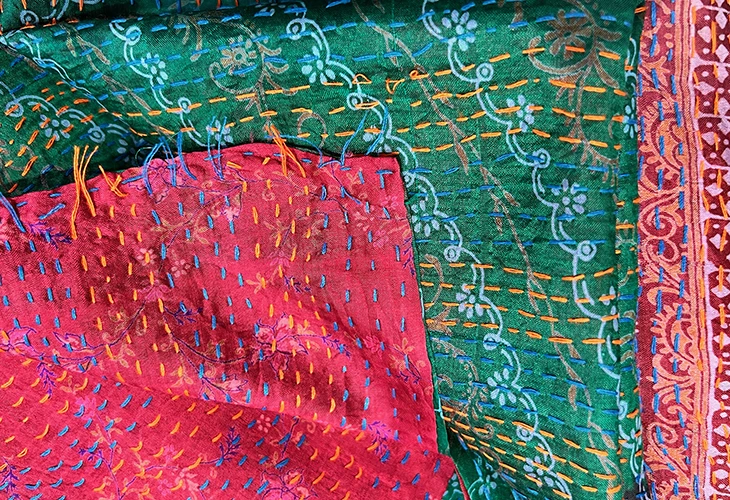
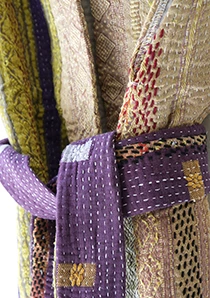
When certain parts of a precious sari become worn or damaged, Indian women keep the usable parts and pair them up to create double-layered pieces, which are then sewn together by hand using topstitching. Each second-hand piece obtained in this way is unique and therefore has a front and a back.
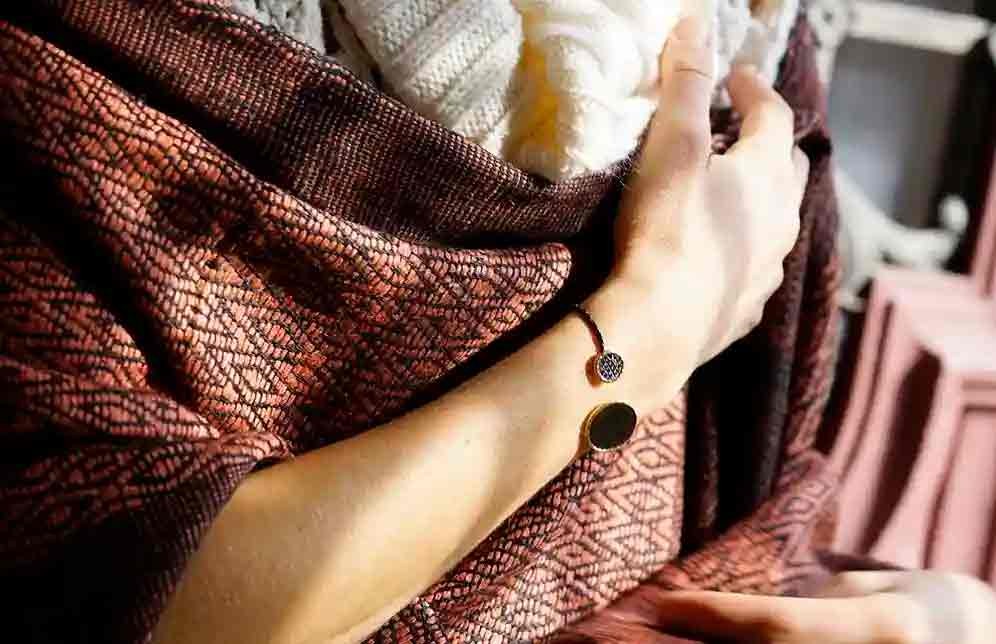
Generally, the new pieces can be used reversibly for completely different purposes: scarves, throws, bedspreads, cushions, etc. The sari that Indian women wrap themselves in with a gesture that only they know how to perform so elegantly must remain a very supple and light fabric.
In rural areas, women traditionally possess this expertise, which gives a second life to all kinds of fabrics, whether cotton or silk. Two fabrics are pressed together and connected by embroidery stitches, creating two unique sides. This assembly allows for harmonious colour and pattern combinations, or striking contrasts depending on the fabrics chosen.
Depending on the thickness, this new fabric can be used to make a stole, bedspread or blanket when quilted between the two layers of fabric. Sometimes several layers are used to make a blanket warm and soft.
The kantha technique, a true art form, is one of the oldest in Indian textile art. It is said to date back to pre-Vedic times, before 1500 BC. Embroidery stitches on silk or cotton with coloured threads were used to draw and create a profusion of floral and geometric patterns, often inspired by nature or mythology.
A plain background is brought to life by the magic of the needle, creating a multitude of animals, plant forms, or characters through the simple effect of embroidery stitches that outline all these figures in a fairy-tale of stitches.
In the past, the art of Kantha expressed the agility, patience and creativity of women from all castes, from the wife of the great landowner to the wife of the sharecropper. It was an important part of women's heritage, passed down from mother to daughter as part of the dowry.
Today, it is a skill learned from childhood by women in rural areas, combining practicality and personal aesthetics, blending domestic economy and craftsmanship.
Most of these women did not have the opportunity to go to school. They practise this craft at home, integrating it into the daily rhythm of their family responsibilities. It offers them the opportunity to become independent by earning an income in contexts where they do not have access to other forms of employment.
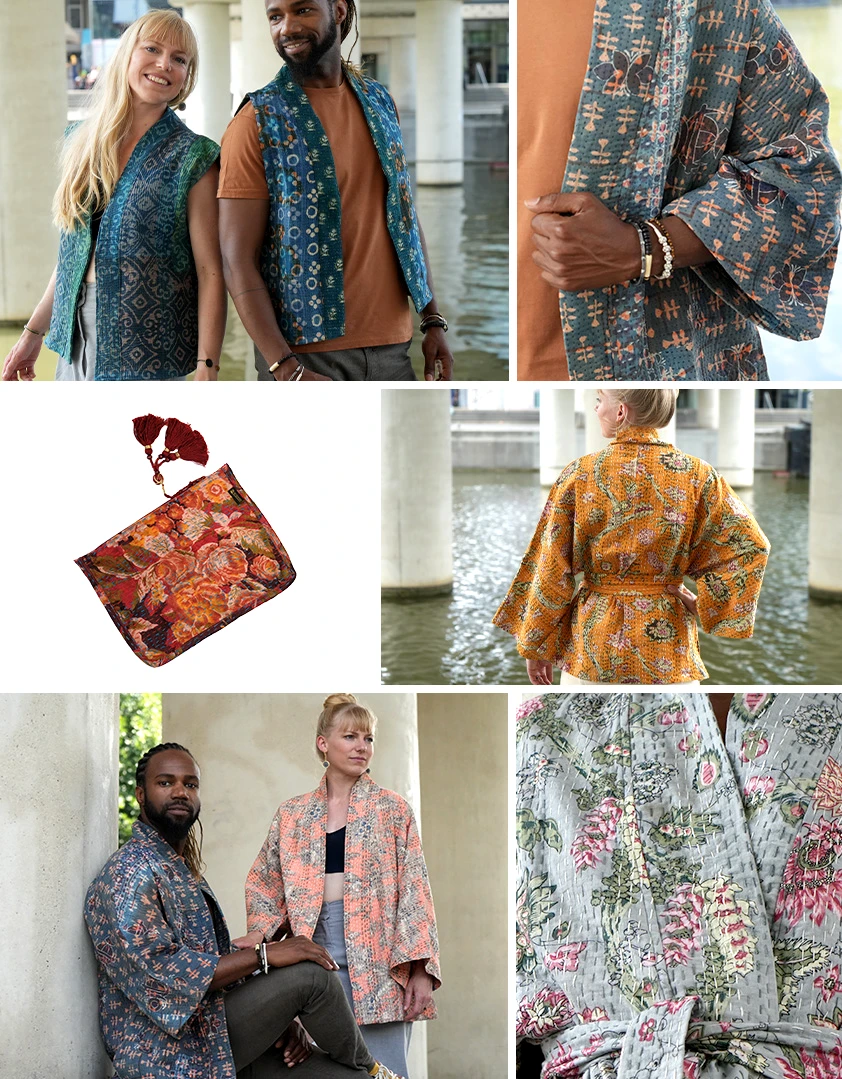
The original fabrics chosen to create the Karawan collection of pouches, waistcoats and scarves have been carefully selected by us for the beauty of their dyeing, their patterns, their colour combinations and for the unique and deep effects of the hand-printed designs. The patterns obtained using traditional woodblock printing or batik techniques make these pieces truly exceptional. Most of the items made by Karawan, such as waistcoats and kimonos, have been dyed using vegetable dyes such as indigo or turmeric.
It is the layers applied by hand in various stages that make these fabrics so vibrant. The batik technique allows areas or points to be reserved from dyeing, while the block print technique allows precise patterns to be applied by colour, in various specific passes for each colour. Some pieces combine the two techniques, giving the fabric a rich and deep visual effect. This is an aesthetic that no industrial production can match.
The fabrics selected by Karawan from a collective of women in Rajasthan were then made into pouches, waistcoats, boleros and kimonos by the women's sewing workshop in Jaipur, with whom we develop our collections in a spirit of solidarity.
The patterns for the cardigans and kimonos are exclusive designs by Karawan, entrusted to Shalini, the master seamstress with whom we co-create our models.
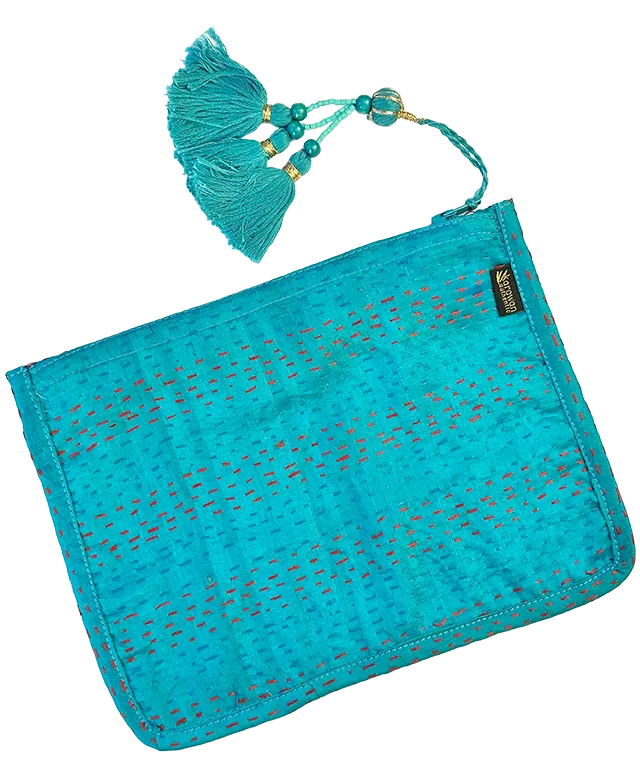
You will discover the refined finishes she applies to each silk kanta clutch bag. Special mention should be made of the tassels, which combine coloured threads in harmony with the colours of the fabric patterns. This attention to detail expresses a taste for beautiful things and the art of taking care in every step of the manufacturing process.
To immerse yourself in the rich and enchanting world of Kantha textile fashion accessories, see our unique collection of clutches, scarves and cardigans.
You will discover a kaleidoscope of colours and traditional Indian patterns combined in a wonderful poetry that tells the story of dreams, love stories and local legends. The slight irregularities in the stitching are a reminder of each textile's unique and personal history.
Dress yourself and decorate your home with the shimmering colours and refined patterns we have carefully selected for you.
You will enjoy unique pieces that only you will wear.
check_circle
check_circle